SPECIAL OFFER • LIMITED TIME

Ruzave Alliance

Get real-time shipping updates, verified business visibility, and growth tools for your Alliance Group — First Come, First Serve.

Ruzave Alliance
Verified Network
📈 Business Growth/Chat
🌍 Global Community
Trusted by shipping professionals • Download the app now

MOL and Hanwha Ocean have designed the first LNG carrier with wind assisted sails to save fuel.

MOL and Hanwha Ocean have designed the first LNG carrier with wind assisted sails to save fuel.
blog image
Maritime

MOL and Hanwha Ocean have designed the first LNG carrier with wind assisted sails to save fuel.

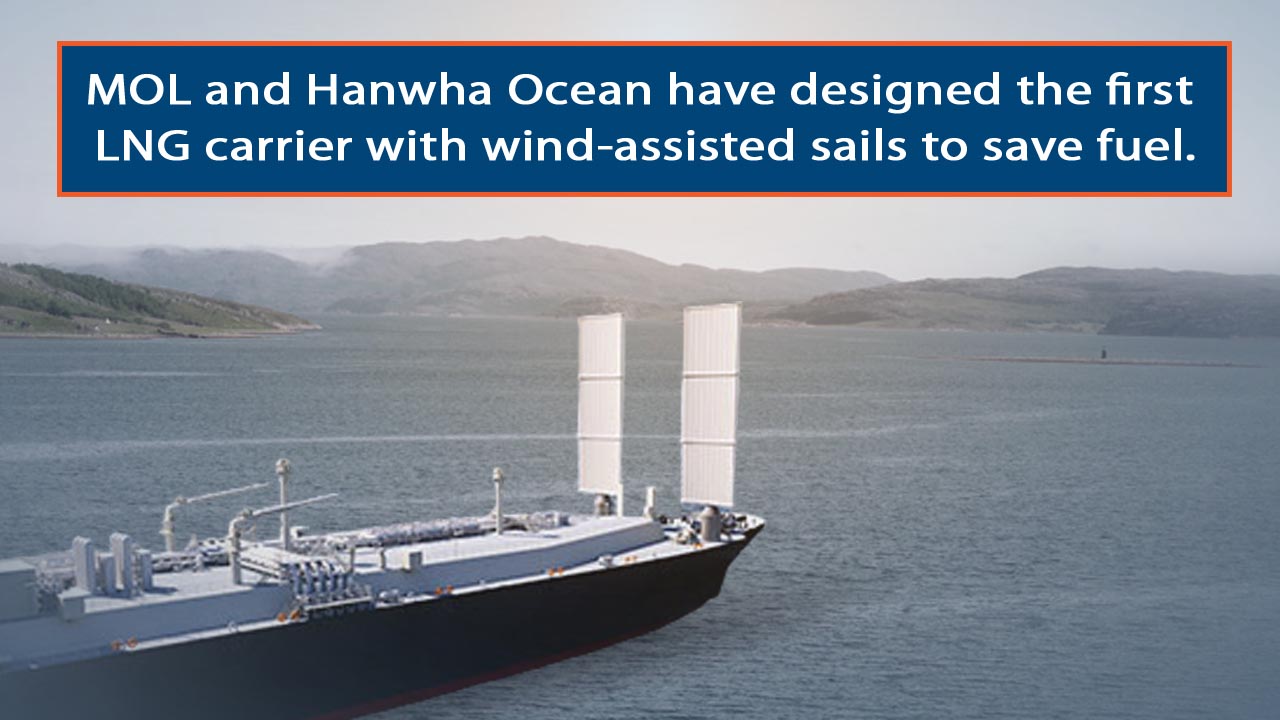
Japan’s Mitsui O.S.K. Lines (MOL) has unveiled a new design for an LNG carrier featuring wind-assisted propulsion. This design incorporates the Wind Challenger, a rigid sail technology first used on bulk carriers. MOL, working with Oshima Shipyard, developed the sail which is made of fibre-reinforced plastic and telescopes with three panels. It’s placed at the front of the ship and has proven effective in reducing fuel use. MOL aims to have 25 ships with this technology by 2030 and 80 by 2035. Now, MOL has teamed up with South Korea’s Hanwha Ocean to adapt this sail technology for a standard LNG carrier. The plan involves fitting two rigid sails onto a new 174,000 cubic meter LNG carrier, each sail standing 160 feet tall and 49 feet wide. This move is part of MOL’s broader strategy to cut carbon emissions and make shipping greener. MOL, Hanwha Ocean, and ClassNK (Nippon Kaiji Kyokai) carried out a thorough risk assessment, looking at sail placement, visibility, emergency procedures, and other safety aspects. As a result, ClassNK granted an approval in principle for the design of this innovative LNG carrier.

05 Aug 24
blog image
Maritime

MOL and Hanwha Ocean have designed the first LNG carrier with wind assisted sails to save fuel.

Japan’s Mitsui O.S.K. Lines (MOL) has unveiled a new design for an LNG carrier featuring wind-assisted propulsion. This design incorporates the Wind Challenger, a rigid sail technology first used on bulk carriers. MOL, working with Oshima Shipyard, developed the sail which is made of fibre-reinforced plastic and telescopes with three panels. It’s placed at the front of the ship and has proven effective in reducing fuel use. MOL aims to have 25 ships with this technology by 2030 and 80 by 2035. Now, MOL has teamed up with South Korea’s Hanwha Ocean to adapt this sail technology for a standard LNG carrier. The plan involves fitting two rigid sails onto a new 174,000 cubic meter LNG carrier, each sail standing 160 feet tall and 49 feet wide. This move is part of MOL’s broader strategy to cut carbon emissions and make shipping greener. MOL, Hanwha Ocean, and ClassNK (Nippon Kaiji Kyokai) carried out a thorough risk assessment, looking at sail placement, visibility, emergency procedures, and other safety aspects. As a result, ClassNK granted an approval in principle for the design of this innovative LNG carrier.


05 Aug 24
blog image
Maritime

MOL and Hanwha Ocean have designed the first LNG carrier with wind assisted sails to save fuel.

Japan’s Mitsui O.S.K. Lines (MOL) has unveiled a new design for an LNG carrier featuring wind-assisted propulsion. This design incorporates the Wind Challenger, a rigid sail technology first used on bulk carriers. MOL, working with Oshima Shipyard, developed the sail which is made of fibre-reinforced plastic and telescopes with three panels. It’s placed at the front of the ship and has proven effective in reducing fuel use. MOL aims to have 25 ships with this technology by 2030 and 80 by 2035. Now, MOL has teamed up with South Korea’s Hanwha Ocean to adapt this sail technology for a standard LNG carrier. The plan involves fitting two rigid sails onto a new 174,000 cubic meter LNG carrier, each sail standing 160 feet tall and 49 feet wide. This move is part of MOL’s broader strategy to cut carbon emissions and make shipping greener. MOL, Hanwha Ocean, and ClassNK (Nippon Kaiji Kyokai) carried out a thorough risk assessment, looking at sail placement, visibility, emergency procedures, and other safety aspects. As a result, ClassNK granted an approval in principle for the design of this innovative LNG carrier.


05 Aug 24