SPECIAL OFFER • LIMITED TIME

Ruzave Alliance

Get real-time shipping updates, verified business visibility, and growth tools for your Alliance Group — First Come, First Serve.

Ruzave Alliance
Verified Network
📈 Business Growth/Chat
🌍 Global Community
Trusted by shipping professionals • Download the app now

First rotor sails have been installed on a MOL Capesize bulker for Vale.

First rotor sails have been installed on a MOL Capesize bulker for Vale.
blog image
Maritime

First rotor sails have been installed on a MOL Capesize bulker for Vale.

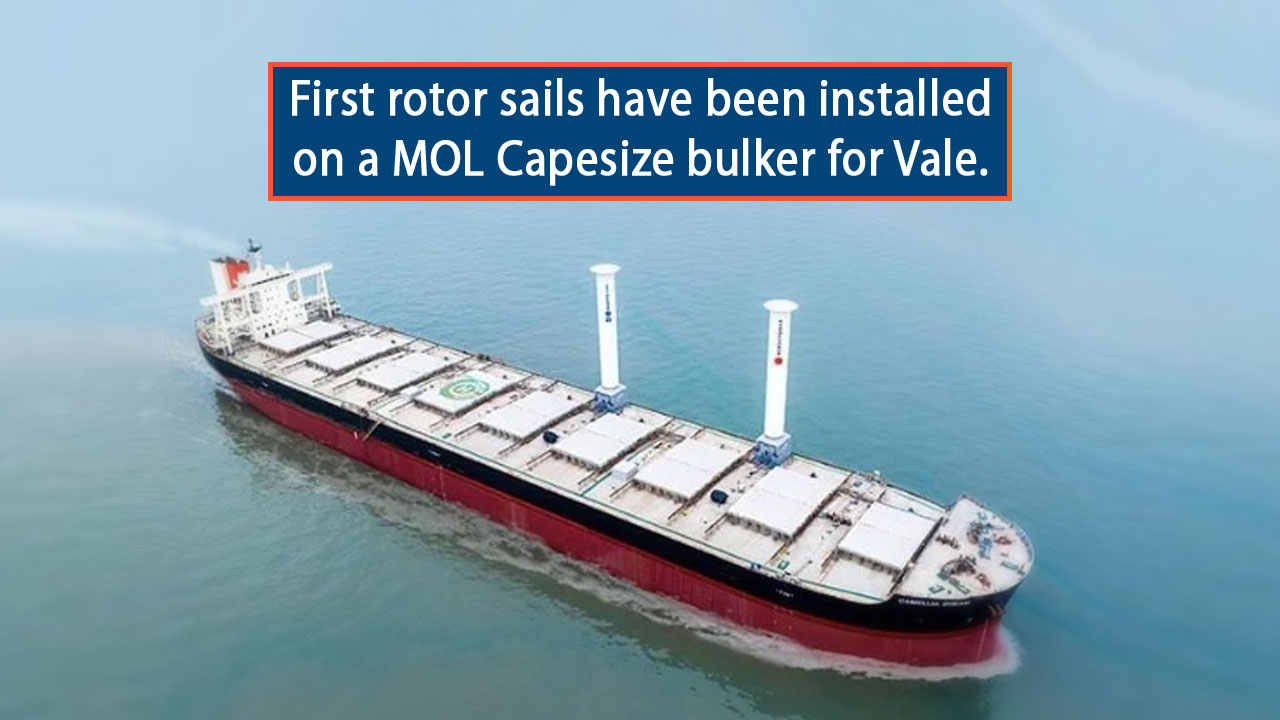
The bulker segment is making significant strides in adopting wind-assisted propulsion technology, with Mitsui O.S.K. Lines and Brazilian mining giant Vale recently achieving a milestone by retrofitting rotor sails to a Capesize bulker. The vessel in question, the Camellia Dream, is a 206,800 dwt bulker built in Japan and delivered a decade ago. It has been retrofitted with two rotor sails manufactured by Norse power, each standing approximately 115 feet (35 meters) tall with a diameter of 16.5 feet (5 meters). This retrofit marks a noteworthy advancement in the deployment of wind-assisted propulsion, extending its use to Capesize bulkers, which are among the largest cargo ships. The Camellia Dream, registered in Japan, embarked on its first voyage following the retrofit from Ponta da Madeira, Brazil, on August 17. It had previously travelled from the Far East and arrived in South America in mid-August. This vessel typically transports iron ore for Vale under a midterm contract with Mitsui O.S.K. Lines, following its regular route. The rotor sails are expected to contribute to approximately 6 to 10 percent reductions in fuel consumption and greenhouse gas (GHG) emissions. This improvement is achieved through a combination of the rotor sails and advanced voyage optimization technology designed to maximize efficiency. This retrofit is part of Vale's broader strategy to reduce its Scope 3 emissions by 15 percent by 20235, a goal that encompasses the emissions associated with its entire value chain, including shipping. Although Vale does not own the vessels, it includes these reductions in its overall supply chain emissions calculations.

22 Aug 24
blog image
Maritime

First rotor sails have been installed on a MOL Capesize bulker for Vale.

The bulker segment is making significant strides in adopting wind-assisted propulsion technology, with Mitsui O.S.K. Lines and Brazilian mining giant Vale recently achieving a milestone by retrofitting rotor sails to a Capesize bulker. The vessel in question, the Camellia Dream, is a 206,800 dwt bulker built in Japan and delivered a decade ago. It has been retrofitted with two rotor sails manufactured by Norse power, each standing approximately 115 feet (35 meters) tall with a diameter of 16.5 feet (5 meters). This retrofit marks a noteworthy advancement in the deployment of wind-assisted propulsion, extending its use to Capesize bulkers, which are among the largest cargo ships. The Camellia Dream, registered in Japan, embarked on its first voyage following the retrofit from Ponta da Madeira, Brazil, on August 17. It had previously travelled from the Far East and arrived in South America in mid-August. This vessel typically transports iron ore for Vale under a midterm contract with Mitsui O.S.K. Lines, following its regular route. The rotor sails are expected to contribute to approximately 6 to 10 percent reductions in fuel consumption and greenhouse gas (GHG) emissions. This improvement is achieved through a combination of the rotor sails and advanced voyage optimization technology designed to maximize efficiency. This retrofit is part of Vale's broader strategy to reduce its Scope 3 emissions by 15 percent by 20235, a goal that encompasses the emissions associated with its entire value chain, including shipping. Although Vale does not own the vessels, it includes these reductions in its overall supply chain emissions calculations.


22 Aug 24
blog image
Maritime

First rotor sails have been installed on a MOL Capesize bulker for Vale.

The bulker segment is making significant strides in adopting wind-assisted propulsion technology, with Mitsui O.S.K. Lines and Brazilian mining giant Vale recently achieving a milestone by retrofitting rotor sails to a Capesize bulker. The vessel in question, the Camellia Dream, is a 206,800 dwt bulker built in Japan and delivered a decade ago. It has been retrofitted with two rotor sails manufactured by Norse power, each standing approximately 115 feet (35 meters) tall with a diameter of 16.5 feet (5 meters). This retrofit marks a noteworthy advancement in the deployment of wind-assisted propulsion, extending its use to Capesize bulkers, which are among the largest cargo ships. The Camellia Dream, registered in Japan, embarked on its first voyage following the retrofit from Ponta da Madeira, Brazil, on August 17. It had previously travelled from the Far East and arrived in South America in mid-August. This vessel typically transports iron ore for Vale under a midterm contract with Mitsui O.S.K. Lines, following its regular route. The rotor sails are expected to contribute to approximately 6 to 10 percent reductions in fuel consumption and greenhouse gas (GHG) emissions. This improvement is achieved through a combination of the rotor sails and advanced voyage optimization technology designed to maximize efficiency. This retrofit is part of Vale's broader strategy to reduce its Scope 3 emissions by 15 percent by 20235, a goal that encompasses the emissions associated with its entire value chain, including shipping. Although Vale does not own the vessels, it includes these reductions in its overall supply chain emissions calculations.


22 Aug 24