All Categories
.png) Maritime
Maritime  Port Terminal Services
  Ocean Logistics
  Air Logistics
  Land Logistics
  Chartering & Broking
 .png) Warehousing
Warehousing  Freight Forwarders
  Association & Institute
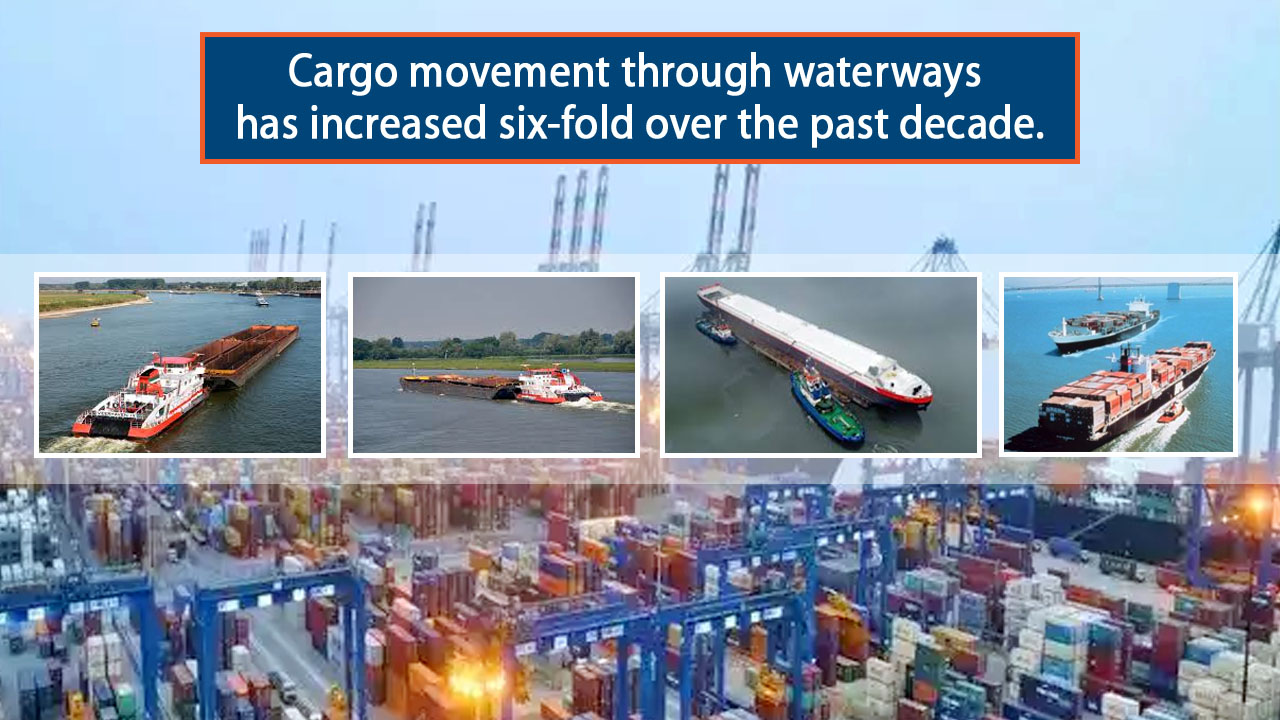
 The significant expansion of cargo movement through waterways in
India is evidenced by a remarkable six-fold increase over the past decade,
largely attributed to the construction of new national waterways. According to
a report by Crisil, cargo transported via these waterways surged from 18.1
million tonnes in the fiscal year 2014 (FY14) to an impressive 132.9 million
tonnes in FY24. The Indian government has set ambitious targets to further
enhance this growth, aiming for 200 million tonnes by FY30 and an ambitious 500
million tonnes by FY47. Currently, the transportation landscape in India is
heavily reliant on road transport, which accounts for 65% of freight movement.
Rail transportation follows at 26%, while the remaining 9% is composed of
various modes, including air transport, pipelines, coastal shipping, and inland
waterways. A pivotal initiative in this growth is the Jal Marg Vikas Project
(JMVP), launched in 2018 with an investment of ₹5,369.18 crore. The JMVP
focuses on expanding the capacity of National Waterway 1 (NW-1), which spans
1,390 kilometres from Haldia to Varanasi along the Ganga-Bhagirathi-Hooghly
river system. This project aims to enhance navigability, infrastructure, and
overall logistics efficiency on NW-1, making it a crucial artery for cargo
movement. The increase in cargo transport via waterways is not only beneficial
for reducing road congestion but also contributes to environmental
sustainability, as it generally has a lower carbon footprint compared to road
and rail transport. As the government continues to invest in and promote the
use of inland waterways, it is expected that this mode of transport will play
an increasingly vital role in India's logistics ecosystem, supporting economic
growth and trade in the years to come.
Maritime
Cargo movement through waterways has increased six-fold over the past decade.
21 Oct 24